|
Case Report
Phenotypic variant of diffuse uterine leiomyomatosis presenting as cellular leiomyoma with retroperitoneal extension: A case report
1 Assistant Professor, Department of Obstetrics and Gynaecology, Sri Madhusudan Sai Institute of Medical Sciences and Research, Muddenahalli, Chikkaballapur, Karnataka, India
2 Associate Professor, Department of Pathology, Sri Madhusudan Sai Institute of Medical Sciences and Research, Muddenahalli, Chikkaballapur, Karnataka, India
Address correspondence to:
Akkamahadevi C Hiremath
Assistant Professor, Department of Obstetrics and Gynaecology, Sri Madhusudan Sai Institute of Medical Sciences and Research, Muddenahalli, Chikkaballapur 562101, Karnataka,
India
Message to Corresponding Author
Article ID: 100232Z08AH2026
Access full text article on other devices

Access PDF of article on other devices

How to cite this article
Hiremath AC, Muniswamy B, Gururaj BC. Phenotypic variant of diffuse uterine leiomyomatosis presenting as cellular leiomyoma with retroperitoneal extension: A case report. J Case Rep Images Obstet Gynecol 2026;12(1):54–58.ABSTRACT
Introduction: Diffuse uterine leiomyomatosis (DUL) is a rare benign smooth-muscle disorder characterized by diffuse myometrial involvement and uterine enlargement. Its radiologic appearance may mimic malignant or extra-uterine disease, creating diagnostic uncertainty. We report an unusual case of DUL with retroperitoneal extension presenting as a giant abdomino-pelvic mass.
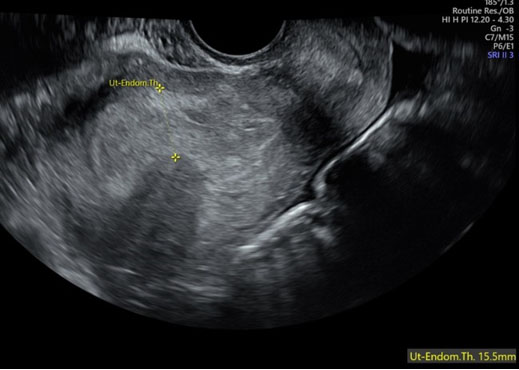
Case Report: A nulliparous woman in her 40s presented with abdominal pain and dyspepsia for six months with recent weight loss, without menstrual complaints. Examination revealed a markedly distended abdomen with a large abdomino-pelvic mass. Serum CA-125 was elevated (276 U/mL), while other tumor markers were within normal limits. Magnetic resonance imaging demonstrated a 26 × 16.5 × 17.5 cm T2-isointense mass occupying the abdomen and pelvis with extra-peritoneal/retroperitoneal insinuation. Differential diagnoses included diffuse leiomyomatosis, leiomyosarcoma, and ovarian neoplasm. Treatment options were discussed, and exploratory laparotomy, was performed with multidisciplinary team. Intraoperatively, a large fleshy mass with multiple projections arising from a normal uterus was identified, extending into the retroperitoneal and paravesical spaces. The appearance differed from diffuse uterine leiomyomatosis, with no evidence of peritoneal leiomyomatosis. She underwent total abdominal hysterectomy with bilateral salpingo-oophorectomy. Postoperatively she developed sudden hypotension requiring emergency re-exploration during which around 1500 mL blood clots were evacuated and a small bleeder of 2 mm in retroperitoneal space was identified and secured. Histopathology revealed a spindle cell neoplasm with increased cellularity, while immunohistochemistry showed Ki-67 <5% and negative S100 excluding malignancy. At one year follow-up, the patient was asymptomatic with no evidence of recurrence.
Conclusion: Diffuse uterine leiomyomatosis is a rare benign entity that may present as a massive abdomino-pelvic mass with atypical retroperitoneal extension, closely mimicking malignant disease. Preoperative diagnosis remains challenging despite advanced imaging. Histopathology and immunohistochemistry are essential for definitive diagnosis. Multidisciplinary surgical management and careful postoperative monitoring are crucial for favorable outcomes.
Keywords: Diffuse uterine leiomyomatosis, Immunohistochemistry, Phenotypic variant, Retroperitoneum
SUPPORTING INFORMATION
Acknowledgments
The authors would like to thank the Departments of Radiology, Pathology, and Anesthesiology for their valuable support in the diagnosis and management of this case. They also acknowledge the contribution of the operating room staff and multidisciplinary surgical team involved in patient care.
Author ContributionsAkkamahadevi C Hiremath - Substantial contributions to conception and design, Acquisition of data, Analysis of data, Interpretation of data, Drafting the article, Revising it critically for important intellectual content, Final approval of the version to be published
Brunda Muniswamy - Acquisition of data, Revising it critically for important intellectual content, Final approval of the version to be published
Vivek Tubagere Gururaj - Acquisition of data, Analysis of data, Interpretation of data, Revising it critically for important intellectual content, Final approval of the version to be published
Guaranter of SubmissionThe corresponding author is the guarantor of submission.
Source of SupportNone
Consent StatementWritten informed consent was obtained from the patient for publication of this article.
Data AvailabilityAll relevant data are within the paper and its Supporting Information files.
Conflict of InterestAuthors declare no conflict of interest.
Copyright© 2026 Akkamahadevi C Hiremath et al. This article is distributed under the terms of Creative Commons Attribution License which permits unrestricted use, distribution and reproduction in any medium provided the original author(s) and original publisher are properly credited. Please see the copyright policy on the journal website for more information.