|
Case Report
Granulosa cell tumor of the ovary: Clinical features, treatment, and outcome factors: A study report of 25 cases
1 Resident Doctor in Obstetrics and Gynecology Department, University Hospital Center Ibn Rochd, Casablanca 20100, Morocco
2 Professor in Obstetrics and Gynecology Department, University Hospital Center Ibn Rochd, Casablanca 20100, Morocco
3 Head of Service in Obstetrics and Gynecology Department, University Hospital Center Ibn Rochd, Casablanca 20100, Morocco
Address correspondence to:
Imane El Abbassi
Department of Gynecology and Obstetrics, University Hospital Center Ibn Rochd, Casablanca,
Morocco
Message to Corresponding Author
Article ID: 100149Z08IA2023
Access full text article on other devices

Access PDF of article on other devices


How to cite this article
El Abbassi I, Joudar I, Khalloufi C, Ennachit M, Benhessou M, El Kerroumi M. Granulosa cell tumor of the ovary: Clinical features, treatment, and outcome factors: A study report of 25 cases. J Case Rep Images Obstet Gynecol 2023;9(1):66–69.ABSTRACT
Introduction: Ovarian granulosa tumors are malignant tumors belonging to the group of sexual cord and stromal tumors. Two histological forms are distinguished: a form of adult which is the most common, and a much rarer juvenile form.
Case Report: Our study is retrospective and concerned 25 cases of ovarian granulosa tumor, collected at the Mohammed VI center for the treatment of gynecological mammary cancers at the Ibn Rochd University Hospital in Casablanca during the period from January 2010 to December 2021. It aims to study the clinical, radiological, anatomopathological, therapeutic, and prognostic features of this tumor.
Conclusion: Granulosa cell tumor of the ovary is a rare malignancy with a particularly slow evolution; got is characterized by the frequency of the stages localized, its tendency to late recurrence. The prognosis of the tumor granulosa of the ovary is relatively good and depends mainly on the stage (FIGO).
Keywords: Chemotherapy, Granulosa tumor, Histological forms, Surgery
Introduction
Ovarian granulosa tumors are malignant tumors belonging to the group of sexual cord and stromal tumors. They represent 0.6–3% of all ovarian tumors and 5% of all ovarian malignancies. They are the most common tumors of the stroma and sex cords [1].
Two histological forms can be distinguished: the adult form, which is the most frequent, and the juvenile form. The latter is distinguished by a relatively younger age of onset, a different morphological appearance with more pronounced histological signs of malignancy and a higher risk of recurrence [2],[3].
Case Report
This work was carried out on 25 cases of ovarian granulosa tumors collected at the Mohammed VI center for the treatment of gynecological mammary cancers at the Ibn Rochd University Hospital in Casablanca during the period from January 2010 to December 2021.
The aim of this work is to analyze the epidemiological aspects of ovarian granulosa tumors, to study their clinical, paraclinical, and anatomopathological characteristics and to describe their therapeutic and evolutionary methods.
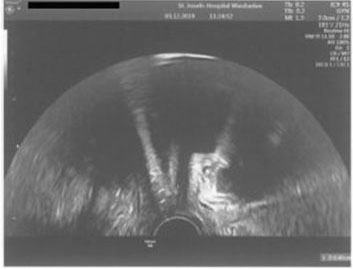
The average age of onset was 48 years with 60% of patients being postmenopausal, and 52% being multiparous. Clinical signs were mainly dominated by abdominal-pelvic pain in 44% of patients; abdominal-pelvic mass in 32% of patients, the endocrine syndrome was dominated by menometrorrhagia, and found in 20% of patients. Sixty percent of patients had clinically palpable pelvic tumors, with a minimum palpable size of 6 cm. Pelvic ultrasound was performed in all patients. Pelvic ultrasound revealed an adnexal mass in 23 patients and a suspicious appearance of malignancy in 30%. Abdominal and pelvic computed tomography (CT) scans were performed in 17 of our patients, and allowed us to determine the size of the masses and their relationship with neighboring structures. Magnetic resonance imaging (MRI) was performed in 7 of our patients. CA125, estradiol, and inhibin were the most requested tumor markers in our series and were elevated in only one case (Ca125: 101 U/mL; Inhibin B: 259 pg/mL).
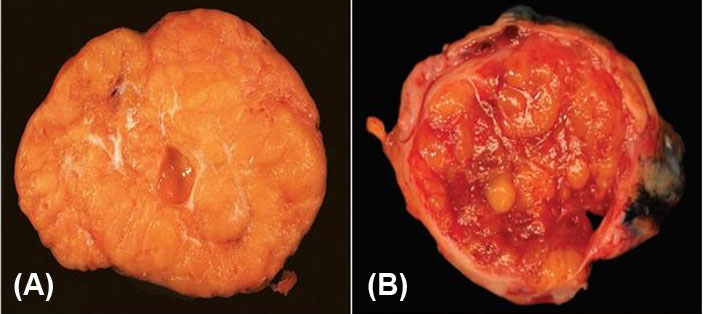
The pathological study showed 23 cases of adult type (92%), and 2 cases of juvenile type (8%). Macroscopically, 18 tumors had a solid cystic component (72%) and 28% of the tumors had a whitish appearance. The micro-follicular architectural appearance was the most common (32% of cases) (Figure 1). At high magnification, the cell nuclei had a coffee bean appearance in 8 patients (32%). Immunohistochemistry was performed in 7 patients, where the most overexpressed markers were vimentin and calretinin. According to the FIGO distribution 68% of the patients had tumors localized to one ovary only. According to the type of surgery performed, 32% of the patients had received conservative treatment and 68% radical treatment. For complementary treatment, 13 patients had received adjuvant chemotherapy (52% of cases), based on BEP, no secondary side effects of chemotherapy have been objectified.
The mean duration of surveillance without relapse was 23 months. The mean duration of relapse in patients who had a recurrence was 24 months. Prognostic factors affecting survival were: Tumor size greater than 10 cm, high mitotic index, and advanced FIGO stage (>IA).
Discussion
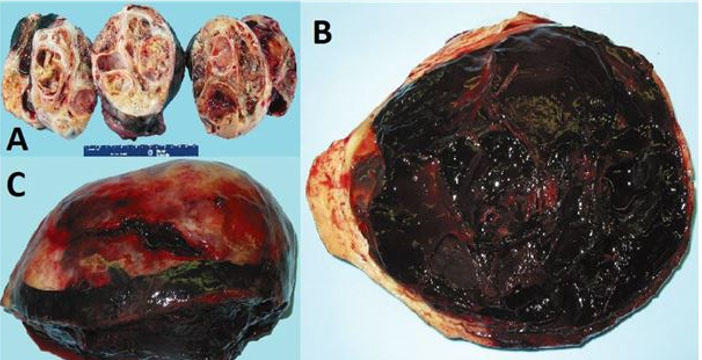
Granulosa tumors are rare ovarian neoplasia. They represent 0.6–3% of all ovarian tumors and 5% of ovarian malignancies. They belong to the group of mesenchymal and sex cord tumors and account for more than 70% of the malignant tumors in this group. The incidence of this tumor was estimated by Lauszus to be 1.3/year/100,000 women [4] (Figure 2).
Two histological forms of granulosa tumors can be distinguished: the adult form, which is the most frequent, and the juvenile form [5]. The latter is distinguished by a relatively younger age of onset, a different morphological appearance with more pronounced histological signs of malignancy and a higher risk of recurrence [6]. The clinical picture is dominated by the tumor syndrome, represented by abdomino-pelvic distension, and the endocrine syndrome, represented by signs of hyperestrogenism [7]. Their diagnosis is anatomopathological, based essentially on morphological and immunohistochemical data [8]. Treatment is based on surgery, which is radical in older women and conservative in younger women who wish to become pregnant, followed by adjuvant chemotherapy depending on the stage. For advanced stages, chemotherapy based on BEP or carboplatin+paclitaxel should be proposed preceded by cytoreductive surgery for stage IIIc [9],[10]. The prognosis remains variable and depends on several parameters. Clinical, ultrasound, and biological monitoring must be prolonged because of very late recurrences [11],[12]. In case of recurrence, surgery remains the reference treatment associated with chemotherapy.
Conclusion
Granulosa tumors are rare malignant tumors, but should be considered in the presence of an ovarian tumor. They can occur at any age, with a predominance in adulthood (post-menopause). They are characterized by their clinical features, by the high frequency of signs of hyperestrogenism, making the granulosa tumor the most frequent endocrine tumor of the ovary.
REFERENCES
1.
Agha RA, Franchi T, Sohrabi C, Mathew G, Kerwan A; SCARE Group. The SCARE 2020 guideline: Updating consensus surgical CAse REport (SCARE) guidelines. Int J Surg 2020;84:226–30. [CrossRef]
[Pubmed]

2.
Cree IA, White VA, Indave BI, Lokuhetty D. Revising the WHO classification: Female genital tract tumours. Histopathology 2020;76(1):151–6. [CrossRef]
[Pubmed]
3.
James D, Mary K, Christian W. TNM Classification of Malignant Tumors. 8ed. Oxford, UK: John Wiley & Sons, Inc.; 2017.
4.
Ray-Coquard I, Pautier P, Pujade-Lauraine E, et al. Rare ovarian tumours: Therapeutic strategies in 2010, national website observatory for rare ovarian cancers and delineation of referent centers in France. [Article in French]. Bull Cancer 2010;97(1):123–35. [CrossRef]
[Pubmed]
5.
Seagle BLL, Ann P, Butler S, Shahabi S. Ovarian granulosa cell tumor: A national cancer database study. Gynecol Oncol 2017;146(2):285–91. [CrossRef]
[Pubmed]
6.
Lazrak I, Laachiri B, Meklaa A, Kouach J, Moussaoui D, Dehayni M. Granulosa-cell tumor of the ovary. International Journal of Innovation and Applied Studies 2014;7(3):1020–4.
7.
Jamieson S, Fuller PJ. Molecular pathogenesis of granulosa cell tumors of the ovary. Endocr Rev 2012;33(1):109–44. [CrossRef]
[Pubmed]
8.
Sekkate S, Kairouani M, Serji B, M’Rabti H, El Ghissassi I, Errihani H. Granulosa cell tumors of the ovary. [Article in French]. Bull Cancer 2014;101(1):93–101. [CrossRef]
[Pubmed]
9.
Zhang J, Young RH, Arseneau J, Scully RE. Ovarian stromal tumors containing lutein or Leydig cells (luteinized thecomas and stromal Leydig cell tumors)—A clinicopathological analysis of fifty cases. Int J Gynecol Pathol 1982;1(3):270–85. [CrossRef]
[Pubmed]
10.
Strickland KC, Nucci MR, Lee KR, Crum CP. Chapter 27 - Sex cord-stromal and miscellaneous tumors of the ovary. Crum CP, Nucci MR, Howitt BE, Granter SR, Parast MM, Boyd TK, editors. Diagnostic Gynecologic and Obstetric Pathology. 3ed. Elsevier; 2018. p. 1011–49. [CrossRef]
11.
Imtinane B, Mghirbi F, Jaidane L, et al. Ovarian granulosa cell tumors: A retrospective study of 21 cases and review of the literature. W J Gynecol Women’s Health 2018;1(2):WJGWH.MS.ID.000506. [CrossRef]
12.
Devouassoux-Shisheboran M, Vacher-Lavenu MC, Observatoire des tumeurs rares gynécologiques (TMRG). Observatoire des tumeurs malignes rares gynécologiquesThe observatory of rare malignant gynecologic tumors. Annales de Pathologie 2014;34(1):70–3. [CrossRef]
SUPPORTING INFORMATION
Author Contributions
Imane El Abbassi - Conception of the work, Design of the work, Acquisition of data, Analysis of data, Drafting the work, Revising the work critically for important intellectual content, Final approval of the version to be published, Agree to be accountable for all aspects of the work in ensuring that questions related to the accuracy or integrity of any part of the work are appropriately investigated and resolved.
Imane Joudar - Conception of the work, Design of the work, Drafting the work, Final approval of the version to be published, Agree to be accountable for all aspects of the work in ensuring that questions related to the accuracy or integrity of any part of the work are appropriately investigated and resolved.
Chadia Khalloufi - Analysis of data, Drafting the work, Final approval of the version to be published, Agree to be accountable for all aspects of the work in ensuring that questions related to the accuracy or integrity of any part of the work are appropriately investigated and resolved.
Mohammed Ennachit - Analysis of data, Revising the work critically for important intellectual content, Final approval of the version to be published, Agree to be accountable for all aspects of the work in ensuring that questions related to the accuracy or integrity of any part of the work are appropriately investigated and resolved.
Mustapha Benhessou - Revising the work critically for important intellectual content, Final approval of the version to be published, Agree to be accountable for all aspects of the work in ensuring that questions related to the accuracy or integrity of any part of the work are appropriately investigated and resolved.
Mohammed El Kerroumi - Analysis of data, Revising the work critically for important intellectual content, Final approval of the version to be published, Agree to be accountable for all aspects of the work in ensuring that questions related to the accuracy or integrity of any part of the work are appropriately investigated and resolved.
Guaranter of SubmissionThe corresponding author is the guarantor of submission.
Source of SupportNone
Consent StatementWritten informed consent was obtained from the patient for publication of this article.
Data AvailabilityAll relevant data are within the paper and its Supporting Information files.
Conflict of InterestAuthors declare no conflict of interest.
Copyright© 2023 Imane El Abbassi et al. This article is distributed under the terms of Creative Commons Attribution License which permits unrestricted use, distribution and reproduction in any medium provided the original author(s) and original publisher are properly credited. Please see the copyright policy on the journal website for more information.