
 |
Case Report
Conservative surgical management of a heterotopic scar pregnancy: A case report
1 MS (Ob/Gy), DRCOG, Dip Gyn Endoscopy, Consultant Gynecologist, Poona Hospital & Research Center, Pune, India
2 MBBS, DMRD, Intervention Radiologist, Poona Hospital & Research Center, Pune, India
Address correspondence to:
Neela Desai
MS (Ob/Gy), DRCOG, Dip Gyn Endoscopy, Consultant Gynecologist, Poona Hospital & Research Center, Pune 411004,
India
Message to Corresponding Author
Article ID: 100154Z08ND2023
Access full text article on other devices

Access PDF of article on other devices


How to cite this article
Desai N, Mutatkar M. Conservative surgical management of a heterotopic scar pregnancy: A case report. J Case Rep Images Obstet Gynecol 2023;9(2):1–6.ABSTRACT
Introduction: The cesarean scar pregnancy is on rise and the objective of this case study is to highlight a different, bold but conservative approach to an unusual challenging case of eight weeks heterotopic cesarean scar pregnancy, which was threatening to rupture.
Case Report: A 31-year-old G3P2L1 previous two cesarean sections presented with lower abdominal pain and bleeding. She was hemodynamically stable, and ultrasonography (USG) and magnetic resonance imaging (MRI) revealed heterotopic pregnancy, eight weeks (gestational sacs > 32 mm) intrauterine and caesarean scar pregnancy, which was threatening to rupture. Since the scar pregnancy was large, BHcG was > 200,000 iu, there was evidence of imminent scar dehiscence; and she was stable and had good blood parameters. The authors decided to take cautious but bold decision of suction evacuation under USG guidance, following the uterine artery embolism. The procedure was smooth and lower segment scar sacculus bleeding was controlled by compression with help of Foley’s balloons inside uterine cavity as well as in bladder. There was no evidence of extrauterine bleeding. She made a good post-operative recovery. Follow-ups consisted of serial BHcG and USG to monitor the regress.
Conclusion: This case study implies that cesarean scar pregnancy, even with imminent scar dehiscence can be managed by USG-guided suction evacuation by experienced hands. Prior uterine artery embolization (UAE) added the safety of bleeding control. This case also emphasizes the importance of a patient monitoring and relying on failing BHcG, and a symptom free patient; and not on mass in CS scar alone which was slow to resolve.
Keywords: Foley’s catheter tamponade, Heterotopic scar pregnancy, Suction evacuation, Uterine artery embolism
Introduction
A heterotopic pregnancy is a rare condition. We came across this case of spontaneous pregnancy with one sac in lower segment scar and another sac at fundus of uterus. There were challenges in the management due to large sac, and eminent disruption of scar pregnancy. A patient conservative approach was taken, and its successful outcome is presented here. We like to share this different approach which can be applied in lower segment scar pregnancy, whenever possible.
The incidence of scar pregnancy is on rise and the medical management with methotrexate in presence of high BHcG (7–8 weeks twin pregnancy) can be very risky and challenging [1]. Surgical approach can end up being very radical. This made us think of a different approach, which can contribute to a rationale practical solution to this dreadful condition.
Case Report
A 31-year-old Gravida3 Para2 Living1 (G3P2L1) with two previous cesarean section (CS) presented on 28th July 2022. Her first CS was for ante partum hemorrhage (APH) (placenta previa) and that neonate didn’t survive. Second elective CS was three years prior, and she had a healthy baby.
She presented with moderate pain in lower abdomen for two days. She also had intermittent per vaginum (PV) bleeding for a week.
She had her normal period on 28th May 2022, with scanty bleeding on 7th July.
On examination, she was hemodynamically stable, but she had tenderness in lower abdomen and anterior fornix with bulky eight weeks size retroverted (RV) uterus with bleeding.
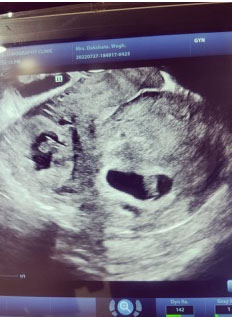
Investigations on 28th July 2022 showed that rest blood parameters were normal; Beta human chorionic gonadotropin (BHcG) was 200179.92; USG showed heterotopic pregnancy with one live pregnancy gestational sac 34.12 mm crown-rump length (CRL) 14 mm (eight weeks) at fundus of uterus, and other gestational sac 32.14 mm CRL 12 mm (7.6 weeks) in lower segment scar (Figure 1).
Magnetic resonance imaging (MRI) confirmed the USG findings along with marked thinning of lower anterior myometrium over 41×54×49 mm highly vascular mass with suspicious dehiscence at 11–12 o’ clock abutting superior wall of urinary bladder. Intra-uterine pregnancy at fundus was also noted (Figure 2).
Procedure on
The patient and her husband were explained about the seriousness of her condition and prospect of surgical intervention at any given time, with possible hysterectomy and bladder injury in view of imminent scar rupture.
Choices of managements were explained to both. As per the medical management giving methotrexate [2] was risky in presence of one live twin pregnancy, > 200,000 iu BHcG, and two >30 mm gestational sacs. The cesarean scar pregnancy was about to rupture leading to serious complication.
The need for emergency surgical management consisting of laparotomy and hysterotomy was a likely possibility. Which had a serious risk of bladder damage, hemorrhage and possible hysterectomy.
The couple were counseled for this conservative surgical approach [3],[4] of suction evacuation after devascularization with uterine artery embolization (UAE). They were explained about the uncertainty of the result; however, the couple accepted this procedure with full understanding. They also accepted the added expenses of uterine artery embolization, with the hope of avoiding major surgery and complications.
- First uterine artery embolization (Figure 3) was done by intervention radiologist under local anesthetics and sedation. Devascularization was achieved, which helped to reduce the bleeding and further complications.
- Suction evacuation in general anesthesia (GA) under USG guidance. After a complete devascularization following uterine artery embolization, the patient was taken to operation theater (OT) for suction evacuation. The bladder was catheterized and Pitocin drip was started. After cervical dilatation, a 9 mm suction cannula introduced in uterine cavity under USG guidance beyond cesarean scar pregnancy (CSP). Intrauterine (IU) pregnancy was easily sucked out. Later CSP was also sucked out. Lower segment was carefully monitored by USG (Figure 4) to exclude any dehiscence and extrauterine bleeding. No evidence of bladder injury, urine remained clear.
The upper segment contracted immediately with no evidence of collection; however, the lower segment pouch was flabby and edematous with active bleeding stopping only by bimanual compression (Figure 5). Hence a Foley’s catheter was introduced in uterine cavity and balloon inflated to compress the lower segment against the Foley’s balloon in bladder (Figure 6). A traction on catheter controlled the bleeding completely. Total blood loss was 300–350 mL. The patient remained hemodynamically stable.
Both catheters removed after 24 hours and there was minimal PV bleeding. Next day 30/7/22, her BHcG was 41,309.0 and USG revealed empty uterine cavity along with minimal collection in LS pouch. She was sent home on 31/7/22 with advice to rest completely and report daily on phone.
Follow-up
4/8/22—The patient was comfortable with minimum pain and bleeding (Figure 6 and Figure 7).
BHcG: The beta HCG value is given in Table 1.
Last menstrual period (LMP) 31/10/22.
USG:
4/8/2022—LS scar edematous complex mass 54×53 mm with peripheral vascularity suggestive of collection in the empty pouch (Figure 7 and Figure 8).
27/8/2022—No IU gestational sac, lower segment cystic lesion 50×49 mm. 8/12/2022—Heterogenous lesion in LS 36×24 mm no symptoms.


Discussion
The incidence of cesarean scar pregnancy (CSP) has been substantially elevated, probably owing to the increasing rate of caesarean deliveries and awareness of this pathology. Despite this prominent increase, no universal treatment guidelines have been established till now [1] and the management of CSP in daily clinical practice is still based on anecdotal case reports.
This case of heterotopic cesarean scar pregnancy is presented here for its unique presentation and risks involved. Challenges of eight weeks heterotopic live pregnancy with each sac more than 32 mm, very high BHcG (>2 L) and imminent dehiscence of scar pregnancy.
Salvaging the IU pregnancy was not a consideration at all. There were risks involved during surgical as well non-surgical way in her management. Methotrexate had limitations [2],[5],[6],[7] because of high BHcG (>200k). The possibility of scar dehiscence while waiting for methotrexate to work in twin pregnancy was not acceptable. Methotrexate injection or potassium chloride injection in the gestational sac had its own risks [2],[5],[6],[7].
Since the patient was hemodynamically stable, had good blood parameters; a decision of surgical suction evacuation under USG guidance after uterine artery embolization was taken. The patient was properly counseled with due consent of laparotomy and hysterectomy with possible bladder injury [6],[8].
An experienced intervention radiologist performed the uterine artery embolization (Figure 3) under sedation and LA. Devascularization of uterus was achieved. This gave us confidence of avoiding a torrential hemorrhage during further surgical procedure [3].
Careful cervical dilatation and suction evacuation were performed under USG guidance. Pitocin drip was started. Both gestational sacs were visibly extracted by suction cannula alone; curette was not used (Figure 4 and Figure 5).
Scar pregnancy sacculus was kept compressed with Foley’s balloon in bladder and uterine cavity to prevent the bleeding filling the sacculus. There was no excessive bleeding. Cesarean scar was intact, confirmed on USG. No methotrexate or misoprost was given.
Post-operatively the patient made smooth recovery with minimal pain and tenderness and intermittent PV bleeding. Scar sacculus was slow to retract and the complex lesion was seen on USG during follow-ups. However, in the absence of any major symptoms, it was only monitored. Slowly it regressed.
She had her first normal menstruation on 30th October, three months after termination of heterotopic pregnancy.
She has been advised against any future pregnancy. She is using barrier method for contraception.
Conclusion
Uterine artery embolization (UAE) and USG-guided suction evacuation can be a safe alternative procedure in CSP in an experienced hand. The authors had previously managed one such patient with cesarean scar pregnancy (CSP) of 6–7 weeks gestation with imminent rupture, in exactly similar manner with uneventful recovery.
However, this case was more challenging because of heterotopic twin pregnancies of 8 weeks gestation both >34 mm sacs and having a 54 mm lesion nearly bursting out of lower segment. There was a suspicion of dehiscence as well.
A first step was to devascularize the uterus by UAE, followed by careful suction evacuation (S&E) under USG guidance, and making sure that all the products of conceptions were visibly removed. Compression of uterine wall on lower segment on both sides helped to stop active bleeding from lower segment.
The pouch of CSP in lower segment was slow to heal and close. Hence there was a persistent presence of mass in anterior myometrium and did raise few concerns. She also had with intermittent PV bleeding.
However, falling BHcG was reassuring, and we could patiently wait for the scar pregnancy (empty) pouch to heal by itself in two months. Since we were confident that there was no retained product of conception, and no chance of the scar giving way or causing bleeding; we could reassure the patient.
Ultrasound-guided suction curettage is an effective method for the treatment of pregnancies implanted into a lower uterine segment Cesarean section scar and is associated with a low risk of blood transfusion and a laparotomy/hysterectomy. A prior uterine artery embolization adds a safety bonus to the surgical procedure by reducing the blood supply to the organ.
REFERENCES
1.
Kanat-Pektas M, Bodur S, Dundar O, Bakır VL. Systematic review: What is the best first-line approach for cesarean section ectopic pregnancy? Taiwan J Obstet Gynecol 2016;55(2):263–9. [CrossRef]
[Pubmed]

2.
Yang H, Li F, Zhang P, Dong J, Wang J, Wang Y. Treatment of caesarean section scar pregnancy with systemic administration of methotrexate. Pak J Pharm Sci 2018;31(5 Special):2287–90.
[Pubmed]
3.
Gu Z, Jia P, Gao Z, Gu W, Zhao H, Zhao S. Uterine artery embolization combined with ultrasound-guided dilation and curettage for the treatment of cesarean scar pregnancy: Efficacy and 5-8-year follow-up study. J Interv Med 2022;5(3):148–52. [CrossRef]
[Pubmed]
4.
Tumenjargal A, Tokue H, Kishi H, Hirasawa H, Taketomi-Takahashi A, Tsushima Y. Uterine artery embolization combined with dilation and curettage for the treatment of cesarean scar pregnancy: Efficacy and future fertility. Cardiovasc Intervent Radiol 2018;41(8):1165–73. [CrossRef]
[Pubmed]
5.
Jurkovic D, Knez J, Appiah A, Farahani L, Mavrelos D, Ross JA. Surgical treatment of cesarean scar ectopic pregnancy: Efficacy and safety of ultrasound-guided suction curettage. Ultrasound Obstet Gynecol 2016;47(4):511–7. [CrossRef]
[Pubmed]
6.
Sánchez-Prieto M, Puy MJ, Barbany N, Graupera B, Pascual MA, Barri-Soldevila P. Conservative management of cesarean scar pregnancy: A case report and literature review. Case Rep Obstet Gynecol 2022;2022:1793943. [CrossRef]
[Pubmed]
7.
Salomon LJ, Fernandez H, Chauveaud A, Doumerc S, Frydman R. Successful management of a heterotopic caesarean scar pregnancy: Potassium chloride injection with preservation of the intrauterine gestation: Case report. Hum Reprod 2003;18(1):189–91. [CrossRef]
[Pubmed]
8.
Gupta R, Vaikousi E, Whitlow B. Heterotopic caesarean section scar pregnancy. J Obstet Gynaecol 2010;30(6):626–7. [CrossRef]
[Pubmed]
SUPPORTING INFORMATION
Author Contributions
Neela Desai - Conception of the work, Design of the work, Acquisition of data, Revising the work critically for important intellectual content, Final approval of the version to be published, Agree to be accountable for all aspects of the work in ensuring that questions related to the accuracy or integrity of any part of the work are appropriately investigated and resolved.
Mukul Mutatkar - Conception of the work, Design of the work, Acquisition of data, Revising the work critically for important intellectual content, Final approval of the version to be published, Agree to be accountable for all aspects of the work in ensuring that questions related to the accuracy or integrity of any part of the work are appropriately investigated and resolved.
Guaranter of SubmissionThe corresponding author is the guarantor of submission.
Source of SupportNone
Consent StatementWritten informed consent was obtained from the patient for publication of this article.
Data AvailabilityAll relevant data are within the paper and its Supporting Information files.
Conflict of InterestAuthors declare no conflict of interest.
Copyright© 2023 Neela Desai et al. This article is distributed under the terms of Creative Commons Attribution License which permits unrestricted use, distribution and reproduction in any medium provided the original author(s) and original publisher are properly credited. Please see the copyright policy on the journal website for more information.


