|
Case Report
Heterotopic pregnancy managed laparoscopically and resulting in successful pregnancy outcome: A case report
1 Department of Obstetrics and Gynecology, Royal Devon University Healthcare Trust, Barnstaple, Devon, UK
Address correspondence to:
Yoseph Eskandar
Medical Student, Oxford University, Medical School, Oxford,
UK
Message to Corresponding Author
Article ID: 100156Z08YE2023
Access full text article on other devices

Access PDF of article on other devices

How to cite this article
Eskandar Y, Lekoudis E. Heterotopic pregnancy managed laparoscopically and resulting in successful pregnancy outcome: A case report. J Case Rep Images Obstet Gynecol 2023;9(2):12–15.ABSTRACT
Introduction: Spontaneous heterotopic pregnancy is extremely rare. It is diagnosed where at least two pregnancies are present simultaneously at different implantation sites, and where one of them is an intrauterine pregnancy. We present a case of heterotopic pregnancy which presented to the early pregnancy assessment clinic with abdominal discomfort at five weeks gestational age.
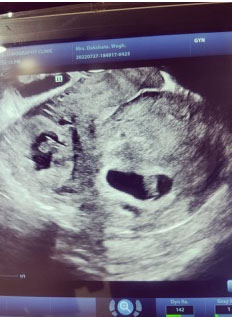
Case Report: A 32-year-old woman presented to the early pregnancy assessment clinic with lower abdominal pain. She was seen in the fertility clinic as she was trying to conceive for more than two years. She was para 2 having had 2 normal vaginal deliveries. She successfully achieved pregnancy on Clomid tablets 50 mg daily from day 2 to day 5 of the cycle. An ultrasound scan in the early pregnancy assessment clinic showed pregnancy of unknown location (PUL) with endometrial thickness of 10 mm at five weeks gestational age. She was subsequently diagnosed with heterotopic pregnancy with extrauterine mass measuring 1.64 cm in size. This was associated with an intrauterine sac with an embryo of about six weeks gestational age. She had laparoscopic right salpingectomy at gestational age of six weeks. She continued with her intrauterine pregnancy until term, and she had spontaneous normal vaginal delivery at 39+4 weeks.
Conclusion: Heterotopic pregnancy is a rare condition, estimated to occur in about 1/30,000 pregnancies. The most common extrauterine location of ectopic pregnancy is the fallopian tube although it can occur in other sites such as cervix, ovary, or anywhere intra-abdominally. Heterotopic pregnancy tends to be overlooked after confirming an intrauterine pregnancy; however, assessment of both adnexae is very important to exclude heterotopic pregnancy. Early detection and treatment of heterotopic pregnancy is key to prevent rupture of the ectopic pregnancy. This has significant consequences in maternal morbidity and mortality and, furthermore, increases the chance of intrauterine pregnancy continuing to term.
Keywords: Heterotopic pregnancy, Intrauterine pregnancy, Successful outcome
SUPPORTING INFORMATION
Author Contributions
Yoseph Eskandar - Substantial contributions to conception and design, Drafting the article, Final approval of the version to be published
Eleni Lekoudis - Substantial contributions to conception and design, Revising it critically for important intellectual content, Final approval of the version to be published
Guaranter of SubmissionThe corresponding author is the guarantor of submission.
Source of SupportNone
Consent StatementWritten informed consent was obtained from the patient for publication of this article.
Data AvailabilityAll relevant data are within the paper and its Supporting Information files.
Conflict of InterestAuthors declare no conflict of interest.
Copyright© 2023 Yoseph Eskandar et al. This article is distributed under the terms of Creative Commons Attribution License which permits unrestricted use, distribution and reproduction in any medium provided the original author(s) and original publisher are properly credited. Please see the copyright policy on the journal website for more information.